By Propzine – Bengaluru’s Trusted PropTech Platform
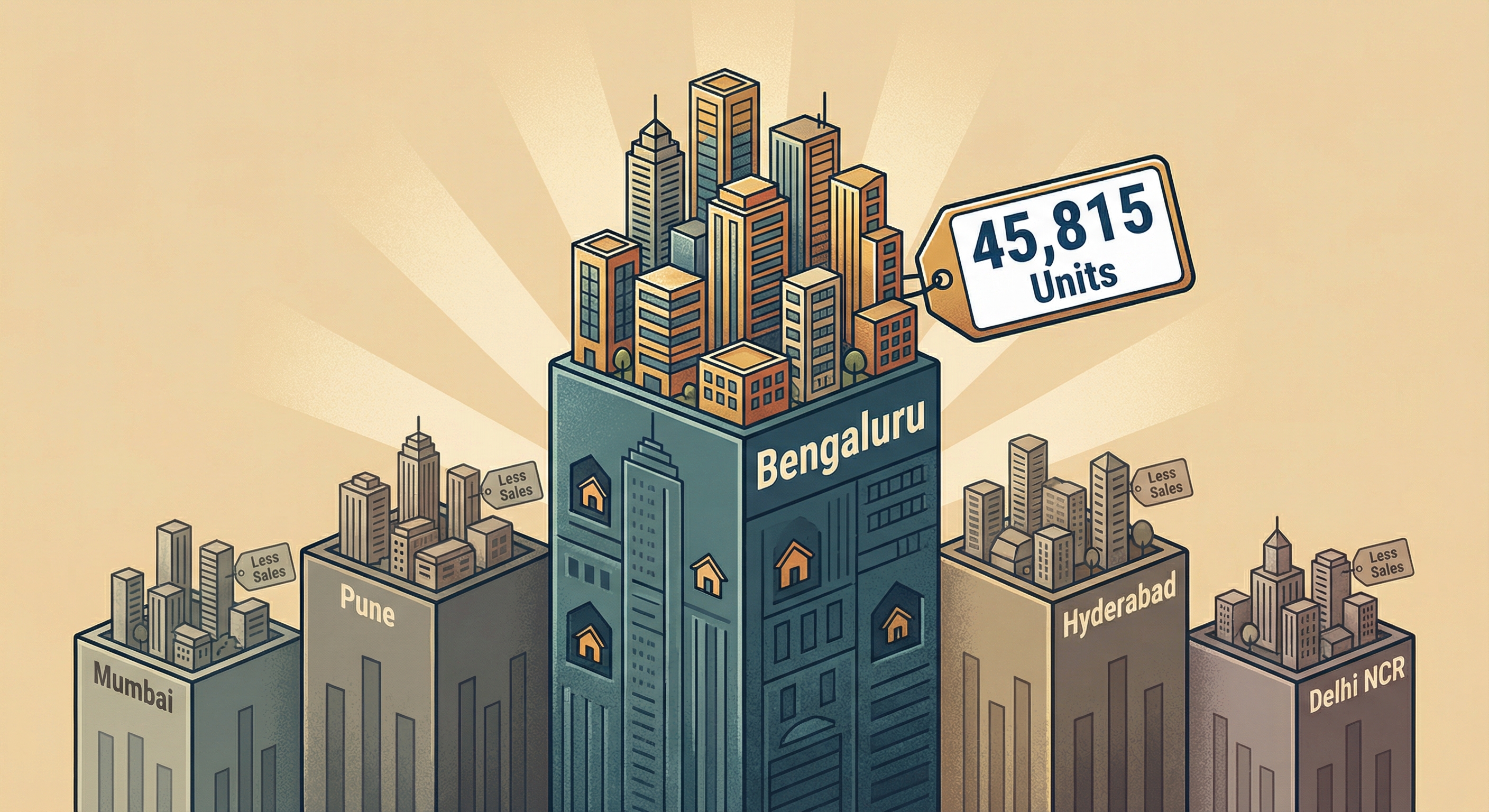
Bengaluru has once again reaffirmed its position as India’s most resilient and high-demand housing market. According to JLL India’s November 2025 data, Bengaluru residential sales in 2025 reached a remarkable 45,815 units between January and September, surpassing both Mumbai (42,398 units) and Pune (40,269 units). This performance highlights the city’s unique combination of deep end-user demand, strong employment fundamentals, and rapid urban expansion—making Bengaluru the undisputed leader of India’s residential real estate cycle.
What makes this momentum even more noteworthy is that the surge in sales came despite an 11% rise in new supply, which expanded to 47,237 units during the same period. In a market where supply often struggles to keep pace with demand, Bengaluru has demonstrated exceptional absorption capacity, driven largely by the premium and mid-segment categories.
For Propzine, headquartered in Bengaluru’s thriving proptech landscape, this data underlines why the city remains the pulse of India’s modern housing ecosystem.
Bengaluru Outperforms Mumbai and Pune: Demand Deepens Across Tech Hubs
The comparison of Bengaluru vs Mumbai housing sales in 2025 tells a compelling story. While Mumbai continues to dominate luxury ticket sizes and redevelopment-led inventory, Bengaluru’s sheer unit sale volume is driven by strong end-user appetite and rapid urban migration linked to the IT, fintech, and GCC ecosystem.
Key highlights from the January–September 2025 period include:
• Bengaluru: 45,815 units sold
• Mumbai: 42,398 units sold
• Pune: 40,269 units sold
The city's performance proves that Bangalore housing market demand is not cyclical—it is structural. Stable job creation, affordability relative to income levels, and strong infrastructure growth have made Bengaluru a magnet for first-time buyers, upgraders, and investors alike.
Tech Corridors Continue to Drive Residential Momentum
The beating heart of Bengaluru’s housing boom lies in its technology corridors. Micro-markets such as Whitefield, Sarjapur Road, Electronic City, Bellandur, and the Outer Ring Road (ORR) continue to outperform others in absorption, price growth, and new launch velocity.
Whitefield: The Epicenter of Demand
Fuelled by the Namma Metro Purple Line extension and massive commercial leasing activity, Whitefield property sales remain the strongest in the city. The market attracts both IT professionals and investors due to its consistent rental yields and rapidly maturing social infrastructure.
Sarjapur Road: The Premium Growth Engine
Sarjapur Road registered some of the highest premium home sales, backed by integrated township launches, new global schools, and the steady expansion of tech campuses. Its connectivity to ORR and Whitefield has made it a preferred destination for young families and upwardly mobile buyers.
Electronic City: The High-Value Upside Market
With big-ticket manufacturing and electronics investments entering Phase 2 and 3 of development, Electronic City continues to see strong uptake in the mid-segment and affordable-premium categories.
Together, these corridors ensure that Bengaluru remains the most diversified and future-ready residential market in India.
The IT Sector Remains Bengaluru’s Housing Backbone
The tech sector continues to be the central economic engine powering Bengaluru’s residential growth. With GCCs expanding aggressively, AI and tech startups scaling hiring, and global R&D centers deepening investment in the city, demand for quality housing remains robust.
Key drivers include:
• Highly paid tech and GCC workforce
• Rising dual-income households
• Strong NRI interest in rental-yield micro-markets
• The hybrid work model driving demand for larger 2.5–3.5 BHK homes
• Higher purchasing power among younger buyers
This employment stability ensures that the Bengaluru market does not depend on speculative investment—unlike several other metros.
Why Bengaluru Will Continue to Lead India’s Housing Market
Bengaluru’s dominance is not just a 2025 phenomenon—it is a long-term structural trajectory.
The city’s housing market is underpinned by:
• Strong affordability ratio compared to Delhi and Mumbai
• One of India’s youngest homebuyer demographics
• High-quality branded supply
• Robust rental demand supporting investor confidence
• Rapid infrastructure upgrades (Peripheral Ring Road, Metro expansions, Satellite Town Ring Road,
STRR)
For Propzine, being headquartered in Bengaluru allows us to stay deeply connected to the market’s pulse and deliver real-time insights, tech-enabled property discovery, and data-backed advisory for our users.
Conclusion: Bengaluru’s Residential Market Is Built on Fundamentals Not Hype
With 45,815 units sold in 2025, 13% price appreciation, and strong absorption across tech corridors, Bengaluru continues to be India’s most stable and future-proof residential market. Even as new supply grows, demand remains unmatched—driven by the city’s thriving tech ecosystem, diverse buyer base, and rising premium housing culture.
As India’s real estate sector enters its next growth cycle, Bengaluru will not just lead—it will define the new blueprint for urban housing demand.